BEATS
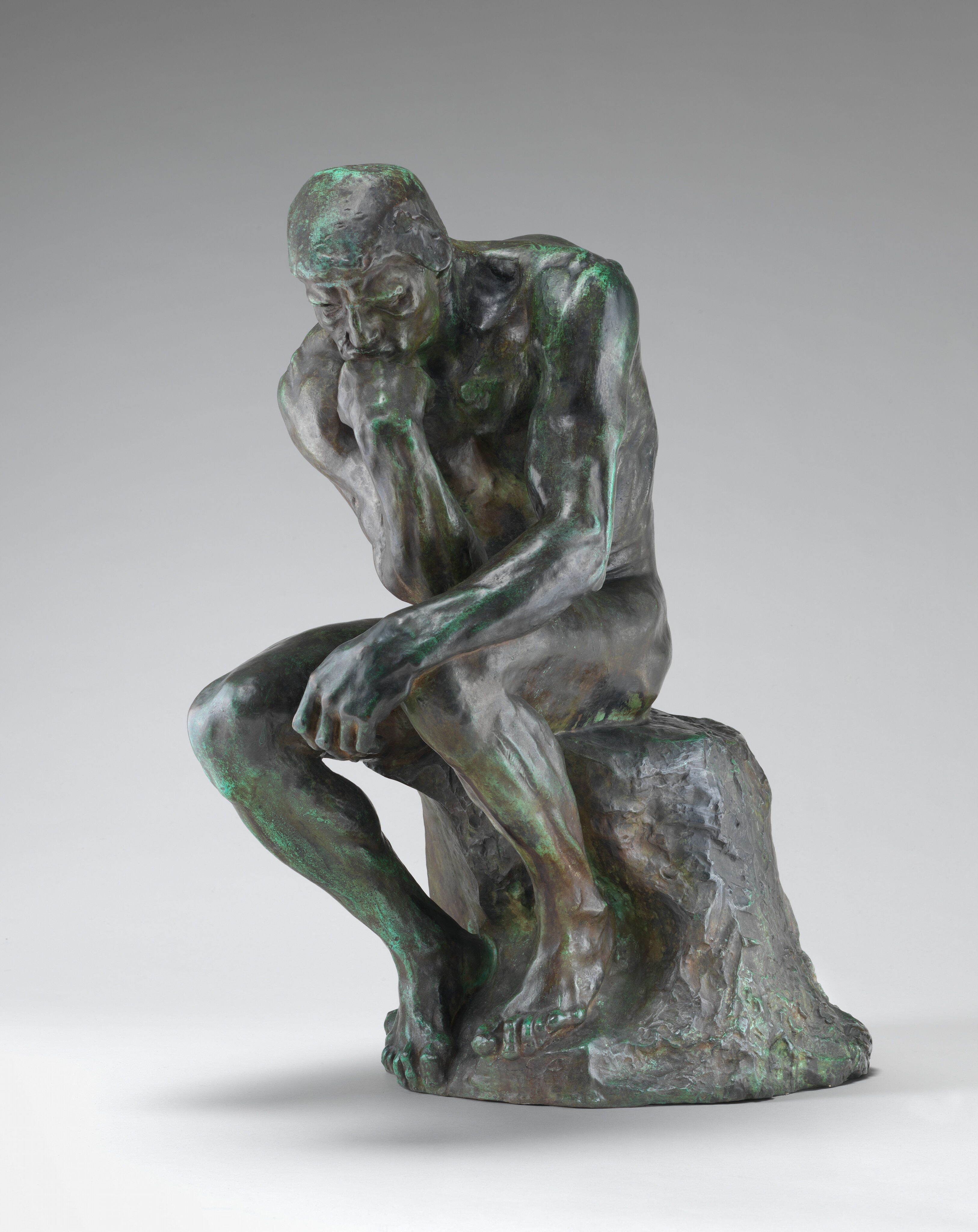
Rodin separated intellectual effort from its conventional depiction — the upward gaze, the finger at the temple, the serene brow — and found the body's actual posture when thought resists conclusion. He made the interior exterior without metaphor. The sculpture doesn't symbolize thought; it demonstrates its physical cost.
The weight lands before the subject registers
The viewer's first response is physical, not intellectual. The compressed mass, the forward lean, the bronze's density — these communicate before any narrative interpretation begins. The hook is somatic.
The conventional depictions are absent
There is no upward gaze, no finger at temple, no serene brow. The viewer scans for familiar "thinking" signals and finds none. This gap creates a productive confusion: what is this body doing?
The correct name arrives: this is what thinking actually feels like
The fist against the mouth, the hunched back, the weight pressing down — the viewer arrives at recognition through their own body, not through symbolic decoding. The emotion isn't assigned; it's discovered.
CRAFT
In 1880 there was no visual vocabulary for depicting concentrated interior thought as a physical state. Rodin's innovation was to make intellectual effort visible — not as a serene muse but as muscular, compressed labor. No prior work in western sculpture had framed cognition as something the body endures.
The Thinker does not depict "a man thinking" — it depicts the exact quality of thought that resists resolution. The clenched fist against the mouth, the hunched back, the weight of the torso pressing down: these are not symbols of thought, they are its physical residue. The emotion is named with forensic precision.
Bronze was the correct material — its weight and permanence reinforce the psychological gravity of the subject. The scale (the enlarged 1904 version stands 186cm) transforms private experience into public monument without losing intimacy. The compression of the pose against the material's natural density creates a formal argument: thinking is a kind of crushing.
Over 120 years, The Thinker has become so culturally embedded it risks cliché — yet the original mechanism survives. Strip the cultural coating and the formal decision remains exact: compressed body, weight forward, fist at mouth. That's still the most accurate image anyone has made of sustained, unresolved thought.
PRINCIPLES
Click any principle to expand · Why & How to apply
SPECIFICITY TEST
If the sculptor were replaced with any peer — Carpeaux, Falguière, Saint-Gaudens — and the commission were identical, the result would have depicted thought as serenity or effort as heroism. The mechanism of The Thinker — interior compression rendered as exterior posture — is not available to a different creative sensibility. This work is fully ownable. It cannot be a category gesture because the category didn't exist before it.
WHAT'S WORTH STEALING
Find the body's posture for the feeling you're working with — not the face, not the symbol. What does the body actually do when it experiences this? Build from that. The Thinker works because Rodin asked a physical question before he asked a narrative one.
WHAT IT COULDN'T DO
The work is permanently vulnerable to over-familiarity. The Thinker is now an emoji, a shorthand, a meme template. This is the cost of total cultural penetration — the mechanism gets buried under accretion. A work this embedded in visual culture can no longer achieve the surprise of recognition it once did for a first-time viewer.